


There’s a very specific kind of bad sleep that shows up before something important.
Not the random bad night at home.
Not the “I had too much caffeine” bad night.
The kind that hits when you’re traveling before a race, before a big presentation, before the event or meeting or competition where you actually need to be sharp.
Even is you do a lot of things right - like bringing your supplements, cutting out the alcohol, trying to get to bed on time - you might find yourself lying there in a perfectly nice hotel room wondering how long you'll be staring at the ceiling.
The next day, you’re left asking the same question a lot of people ask:
Did that bad night actually cost me?
In some cases it may - in others, you can certainly power through. But why is this struggle happening in the first place?
It’s called the first-night effect.
Your Brain Doesn’t Fully Trust a New Room
In 2016, researchers at Brown University published one of the most interesting sleep studies I’ve read in Current Biology. They found that when people sleep in an unfamiliar environment, one hemisphere of the brain stays more vigilant than the other - essentially acting like a night watch while the rest of the brain tries to sleep.
The researchers specifically observed that the left hemisphere remained more responsive to deviant sounds during deep sleep on the first night in a new environment. In other words, part of your brain is still scanning for danger.
That’s why this issue feels so frustrating. You can be in a safe, quiet, expensive hotel room - and your brain still acts like you’re in an unfamiliar cave with something potentially lurking outside.
As Yuka Sasaki, one of the study’s senior authors, put it in Brown’s write-up of the research, “In Japan they say, if you change your pillow, you can’t sleep.” The study suggested that instinct isn’t superstition - it’s rooted in real brain behavior.
The First-Night Effect Is Real Enough That Researchers Plan Around It
Sleep researchers have known about the first-night effect for a long time. In sleep-lab research, it’s so common that the first night is often treated as an adaptation night, and researchers may discount or disregard that data before drawing conclusions from later nights.
That’s because the first night in a novel sleeping environment is frequently associated with:
- longer sleep onset latency
- lower sleep efficiency
- more wakefulness after sleep onset
- longer REM latency
- and less REM sleep overall
That’s not just “sleeping a little lighter.” That’s a meaningful shift in sleep architecture.
And if you’re traveling before a race, a competition, or an important work event, it can absolutely matter.
Why This Feels Especially Brutal Before High-Stakes Days
The worst part about the first-night effect is that it often shows up when the stakes are already elevated.
You’re not just in a different room. You’re also dealing with:
- anticipatory stress
- a schedule shift
- travel fatigue
- different food and hydration
- different noise and lighting
- a different pillow and mattress
- and often a much stronger desire to “sleep well tonight”
That last part - the mental component - matters alot too.
Sleep is one of the few things where trying harder can make it worse.
So now your brain is:
- more vigilant because the room is unfamiliar
- more aroused because tomorrow matters
- and more aware of every little sleep disruption because you’re looking for signs that you’re not sleeping well
That’s a rough combination, and it’s also why people often remember these nights so vividly. The bad hotel night before something important has a way of sticking with you.
This Isn’t Just About Feeling Groggy
Poor sleep in a hotel doesn’t just mean you’re a little tired.
When sleep is shortened or fragmented, the effects can show up in:
- reaction time
- mood regulation
- pain tolerance
- decision-making
- cognitive flexibility
- perceived exertion the next day
Sleep restriction has been repeatedly linked to impaired executive function and reduced cognitive performance, especially when the next day requires precision, judgment, or emotional control.
So if you wake up after a rough first hotel night and feel slightly off, there’s a reason.
What Actually Helps
The frustrating part of the first-night effect is that you can’t really talk yourself out of it - but you can work around it.
1. Arrive a night early if the stakes justify it
This is the cleanest fix.
If the race, event, or presentation matters enough, arriving one night early gives your brain a chance to adapt. By the second night in the same environment, the asymmetry seen in the first-night effect drops substantially or disappears.
This is also why adaptation nights are common in sleep studies. Researchers know the first night is noisy data.
If you’re traveling for something important, the extra hotel night may be one of the highest ROI expenses you can make.
2. Make the pre-sleep routine feel exactly the same
Your brain is scanning for novelty. The more familiar your inputs are, the fewer things it has to treat as potentially important.
That means:
- keep the same rough bedtime
- do the same wind-down in the same order
- keep the lighting low
- avoid turning the night into “travel mode”
- don’t suddenly introduce a bunch of “sleep hacks”
This is not the night to experiment with anything new.
3. Bring something familiar to sleep with
This is where a lot of customer behavior suddenly makes perfect sense.
Over the years, we’ve heard some version of this over and over again:
“I can’t sleep without my Lagoon pillow when I travel.”
At first, that just sounded like preference, but now it sounds like neuroscience.
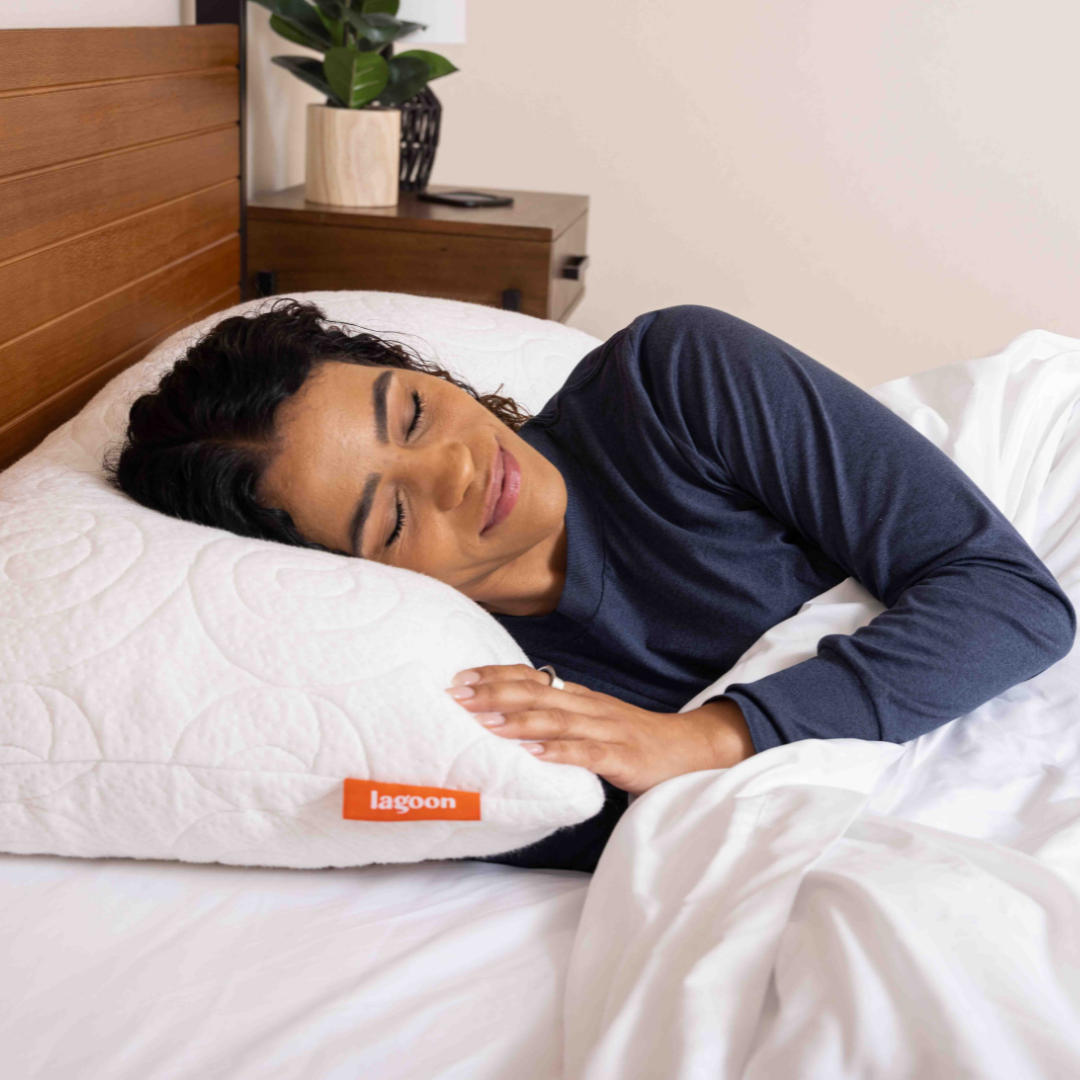
If your brain is looking for familiar signals that this environment is safe enough to fully downshift, bringing something familiar matters. A pillow is one of the most direct, immediate sensory inputs in your sleep environment. It affects touch, smell, head position, and physical alignment all at once.
That’s one of the reasons we make both a travel pillow and a travel bag that fits our full-size pillows. If you travel often - especially for things that matter - controlling that part of the sleep setup gives you one less variable working against you.
4. Control the variables you actually can
Travel already throws a lot at you.
You may not be able to control the hotel mattress, hallway noise, or altitude. But you can usually control:
- your routine
- your bedtime window
- the temperature
- the blackout level of the room
- your pillow situation
-
what you do in the hour before bed
When your sleep is under pressure, it helps to focus on the things that are actually movable.
The Bigger Point
The first-night effect is a good reminder of something bigger:
Sleep is not just about “good habits” - it’s about your environment and context or timing.
A lot of people think they’re bad sleepers when the reality is that their brain is just doing exactly what it evolved to do in a new environment. On the first night somewhere unfamiliar, it stays slightly more alert. It keeps watch.
That’s useful if you’re sleeping outdoors with predators nearby... but it may be less useful if you’re in a Marriott in Denver trying to rest up before a marathon.
Your brain doesn’t care - so you need to find a way to work with it, controlling the levers that you can.
And when the next day arrives, you'll know you've done all in your power to show up your best.