


Snoring is one of those sleep problems people tend to talk about casually.
Someone gets blamed at breakfast. Someone complains to a friend. Someone says their husband, wife, boyfriend, girlfriend, or roommate sounded like a lawn mower at 2am. It becomes part of the normal language of relationships and family life, especially because almost everyone has either snored, slept next to someone who snores, or heard someone snoring through a wall.
That casualness makes sense. Snoring can be funny from a distance.
It feels less funny when you’re the person lying awake next to it.
The more you look at the data, the more obvious it becomes that snoring occupies an odd space in sleep health. It’s incredibly common, and in many cases it is not dangerous on its own. At the same time, it can seriously affect the sleep of the person next to the snorer, and it can sometimes be a sign that breathing is being disrupted during sleep.
So the question isn’t whether snoring is normal.
It often is.
The better question is whether it has gotten disruptive enough that it deserves attention.
How Common Is Snoring?
Snoring is much more common than people probably realize.
The American Medical Association cites estimates that about 25% to 50% of adults snore regularly. It also notes that 90 million Americans report snoring at least sometimes, while 37 million report snoring regularly. The National Sleep Foundation reports similar numbers and says 42% of men and 31% of women say they snore.
Those numbers are large enough that snoring can start to feel like something everyone just has to tolerate.
But the impact on sleep partners is not small.
A Sleep Foundation survey found that 75% of people who share a bed with a snorer say the snoring affects their sleep, and 77% say it affects their well-being in some way. In the same survey, 44% said their partner’s snoring made them tired the next day, 33% said it made them cranky or moody, and 28% said they had no energy.
That’s the part people tend to underplay. Snoring is not always a minor annoyance. For a lot of couples, it becomes a nightly sleep disruption.
And sleep disruption has consequences.
Why People Snore
Snoring happens when airflow is partially blocked or narrowed during sleep, causing tissues in the throat or airway to vibrate.
Virginia Skiba, MD, a neurologist and sleep medicine physician quoted by the American Medical Association, explains it simply: “Snoring in and of itself is caused by vibration of the tissues in the back of the throat.” When air moves through and those relaxed tissues vibrate, you get the sound people recognize immediately.
Several things can make that more likely:
- sleeping on your back
- alcohol close to bed
- nasal congestion or allergies
- anatomy of the mouth, throat, or sinuses
- excess weight, especially around the neck
- being overtired
- pregnancy
- aging, as throat and tongue muscles lose tone
- certain medications that relax the airway
That list matters because it means snoring is not one single problem. For one person it may be congestion. For another, it may be alcohol. For another, it may be sleep position. For another, it may be a sign of obstructive sleep apnea.
The best fix depends on what’s actually contributing to it.
Why Back Sleeping Often Makes Snoring Worse
Sleep position is one of the most practical places to start.
Mayo Clinic notes that snoring is often louder and more frequent when someone sleeps on their back because gravity can narrow the airway. Mayo sleep specialist Dr. Lois Krahn puts it this way: “Sleeping on the back means that your tongue and jaw can fall down and crowd your airway. And many people snore more on their back.”
That’s why side sleeping is so often recommended for people who snore or have obstructive sleep apnea. Mayo Clinic says most forms of obstructive sleep apnea are milder when people sleep on their side, and its guidance specifically recommends side sleeping rather than back sleeping when OSA is a concern.
This is also where pillow support becomes relevant.
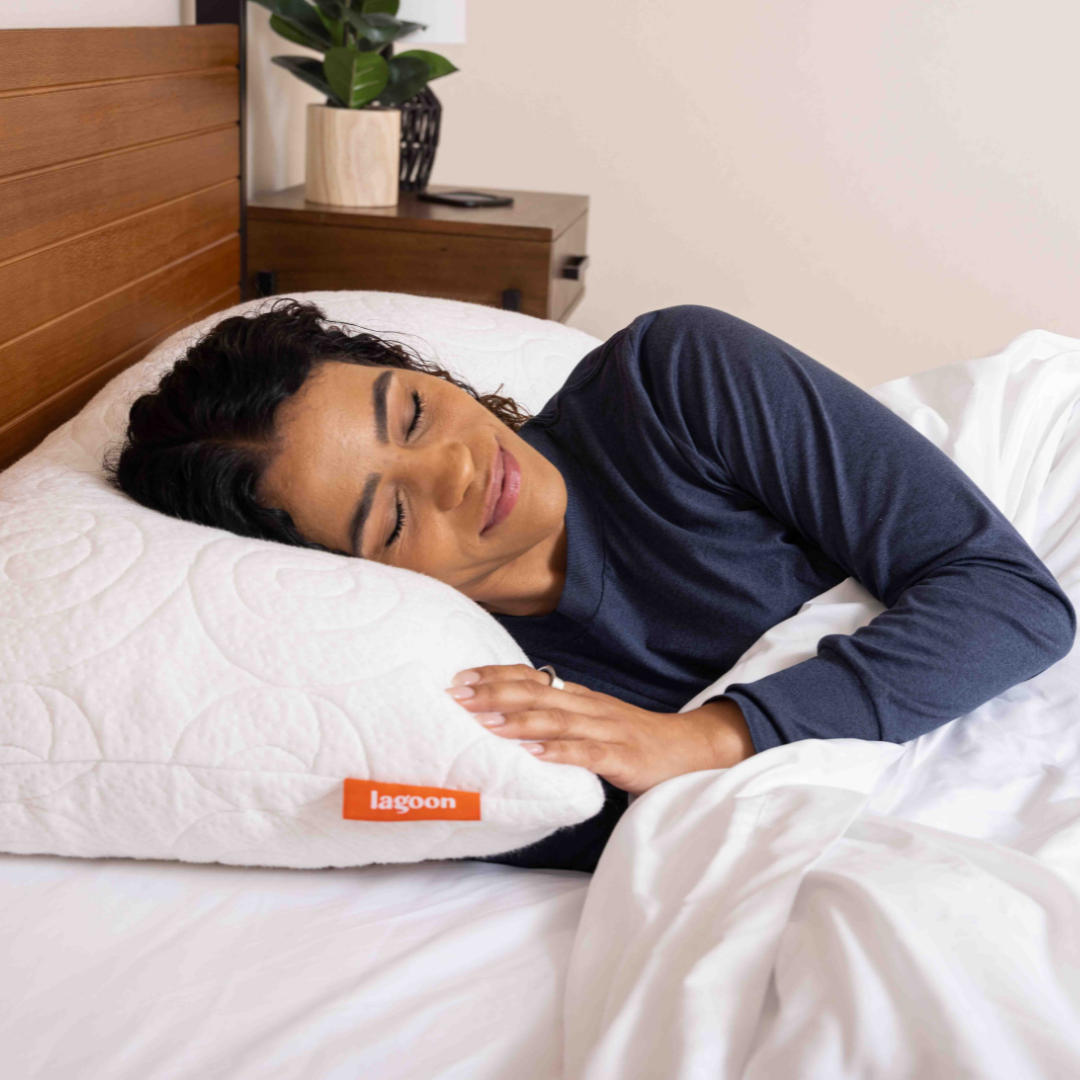
A pillow will not treat sleep apnea. It should not be framed as a medical solution. But pillow height and support can affect head and neck position, and head and neck position can affect how comfortable it is to maintain side sleeping or a slightly elevated posture. Sleep Foundation notes that, for many people, snoring is affected by sleeping position, and a pillow that properly supports the head and upper body may help reduce airway compression related to poor positioning.
That’s the useful distinction.
A pillow is not a cure. But the right pillow can help support a better sleep position, improve comfort, make side sleeping easier to maintain, and help keep the airway from getting crowded by poor head and neck alignment.
When Snoring Becomes a Medical Concern
Sometimes snoring is just snoring.
Light, occasional snoring is usually not a major health concern by itself. Sleep Foundation describes light, infrequent snoring as normal and says its main impact is usually on a bed partner or roommate.
Frequent, loud, disruptive snoring is different. It may still be primary snoring, but it can also be a sign of obstructive sleep apnea, especially when paired with other symptoms.
Obstructive sleep apnea, or OSA, happens when the upper airway repeatedly becomes partially or fully blocked during sleep. That can lead to breathing pauses, drops in oxygen, and repeated arousals that fragment sleep. The person may not fully wake up or remember these events, but the body is still being interrupted throughout the night.
That matters because the snorer may be losing sleep quality without realizing why.
Sleep Foundation recommends talking with a doctor if snoring is very loud, occurs three or more times per week, includes gasping, choking, or snorting sounds, or comes with daytime drowsiness, lack of focus, morning headaches, high blood pressure, or frequent nighttime urination.
Mayo Clinic’s patient guidance includes similar warning signs. A healthcare professional may ask whether someone snores, whether the snoring disrupts anyone else’s sleep, whether there is gasping or choking, whether anyone has witnessed breathing pauses, and how refreshed the person feels in the morning.
That’s an important point for couples.
The person next to the snorer often knows more about the problem than the snorer does.
The Partner’s Sleep Counts Too
Snoring creates a strange dynamic because one person makes the sound and the other person often feels the consequence first.
The snorer may wake up thinking the night was fine. Their partner may wake up feeling like they spent half the night nudging, listening, rolling away, putting in earplugs, or considering whether to move to another room.
Sleep Foundation’s survey data shows how real that impact can be. Among people sharing a bed with a snorer, 75% said snoring affected their sleep, and many reported next-day tiredness, crankiness, low energy, and trouble concentrating.
Wendy Troxel, PhD, a senior scientist at RAND, put it well in Sleep Foundation’s coverage: “When you share a bed, your sleep is not just your own. It’s interdependent.”
That’s a good way to think about it.
In a shared bed, one person’s sleep behavior can become the other person’s sleep problem. Snoring is one of the clearest examples.
This is also why some couples eventually choose to sleep separately. People sometimes talk about “sleep divorce” like it is a modern trend, but plenty of couples have been doing some version of it for years. Usually not because they don’t want to be close, but because one or both people finally need to sleep.
There is nothing wrong with protecting sleep. But before separate bedrooms become the default, it is worth asking whether the snoring itself can be improved.
Practical Steps That Can Help Reduce Snoring
The right approach depends on the cause, but several strategies are commonly recommended.
Try side sleeping
For many snorers, sleeping on the back makes the problem worse. Side sleeping can help reduce airway crowding and is often recommended when snoring or obstructive sleep apnea is part of the picture.
The challenge is staying on your side comfortably. If your pillow is too low, too high, too flat, or too firm in the wrong way, side sleeping may create neck or shoulder discomfort. That discomfort can push people back into positions that make snoring worse.
A supportive pillow can make the side-sleeping position easier to maintain.
Limit alcohol close to bed
Alcohol relaxes the muscles of the throat and can worsen snoring. The National Sleep Foundation specifically lists alcohol consumption before bed as a factor that can reduce airflow and increase vibration. Mayo Clinic also recommends avoiding alcohol close to bedtime when obstructive sleep apnea is a concern.
This does not mean someone can never have a drink. But if snoring is bad, alcohol timing is one of the most obvious variables to test.
Treat congestion and allergies
Blocked nasal passages can make airflow harder and increase snoring. The National Sleep Foundation lists colds, sinus problems, and allergies as common contributors. Mayo Clinic also recommends keeping nasal passages open and discussing decongestants or antihistamines with a healthcare professional when congestion is part of the issue.
If snoring gets worse during allergy season or when someone is sick, this is likely part of the equation.
Keep up with health and fitness
Excess weight, particularly around the neck, can narrow the airway and contribute to snoring. The National Sleep Foundation notes that excess weight can narrow airways, and the AMA says people who are overweight are more likely to snore.
This is not about shaming anyone. It’s just one of the variables that can influence airflow during sleep.
Get evaluated if the warning signs are there
This is the part people should not ignore.
If snoring is loud, frequent, paired with gasping or choking, connected to morning headaches, or followed by significant daytime sleepiness, it is worth talking to a doctor. A sleep study may be appropriate.
Snoring alone is common. Snoring with disrupted breathing is a different conversation.
Check your pillow and sleep position
This is one of the simplest things to evaluate at home.
Ask a few questions:
- Is your pillow old or collapsed?
- Does your head fall too far back?
- Is your chin pushed too far toward your chest?
- Can you comfortably stay on your side?
- Do you wake up with neck or shoulder discomfort?
- Do you end up on your back because your side-sleeping setup is uncomfortable?
A good pillow should support your head and neck in a way that makes your preferred sleep position easier to maintain. For snorers, that often means helping support side sleeping and keeping the head, neck, and upper body in a more comfortable alignment.
Again, this is not a medical treatment for sleep apnea. But it is a very reasonable place to start if position and comfort seem to be contributing.
What a Pillow Can and Cannot Do for Snoring
A pillow can help with comfort, alignment, and position.
It may help make side sleeping easier. It may help prevent the head from dropping into a position that crowds the airway. It may help reduce the tendency to roll onto the back if side sleeping is more comfortable.
A pillow cannot diagnose sleep apnea. It cannot replace a CPAP machine, oral appliance, medical evaluation, or sleep study. It cannot fix every cause of snoring.
That line is important.
The right pillow is part of the sleep environment. For some people, that can make a meaningful difference. For others, especially those with signs of obstructive sleep apnea, the next step should be medical.
How to Talk About Snoring Without Turning It Into a Fight
This may be the most practical part.
Snoring gets personal quickly because the snorer often does not know how bad it is. They are asleep. They may feel accused. The partner may feel ignored or dismissed. Both people can be tired, which never helps communication.
It usually goes better when the conversation sounds less like blame and more like a shared sleep problem.
A few helpful ways to frame it:
“I’m not trying to make you feel bad, but your snoring is waking me up regularly.”
“I think this may be affecting your sleep too.”
“Can we try a few changes before this becomes something we just live with?”
“I’m worried because there are times it sounds like your breathing is disrupted.”
That last line matters if there is gasping, choking, or breathing pauses. In that case, this is no longer just about the partner being annoyed.
The Bottom Line
Snoring is easy to normalize because it is everywhere.
People joke about it. Couples complain about it. Families hear it down the hall. For a lot of people, it becomes one of those things everyone just accepts.
But if snoring is regularly disrupting sleep, it is worth taking more seriously.
Start with the simple things. Sleep position. Alcohol timing. Congestion. Fitness. Pillow support. A more comfortable side-sleeping setup.
If the snoring is loud, frequent, or paired with signs of disrupted breathing, talk to a doctor.
Because better sleep should not require one person lying awake all night while the other person unknowingly ruins the room.
And if your pillow is part of the problem, that’s one place Lagoon can help. Take our 2-minute Sleep Quiz to find the pillow that best supports how you actually sleep, including side sleeping, alignment, comfort, and the setup that helps you stay in a better position through the night.